Rozzom H1 Quadcopter Drone
A camera drone that sees obstacles with lidar as well as cameras, flown with a handheld screen remote.
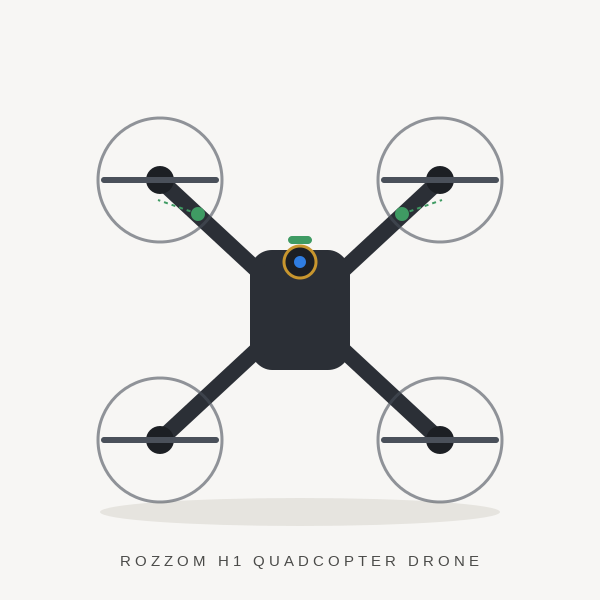
- Front lidar: a lidar sensor on the front of the body, looking ahead
- Side lidars: a lidar at the tip of each front arm, turned 90° to look out to the left and to the right
- All-around cameras: obstacle-sensing cameras that watch in every direction
- Screen remote: a handheld remote with its own built-in screen, so you do not need a phone to fly
Specifications
| Type | Quadcopter (four rotors) camera drone |
|---|---|
| Obstacle sensing | Omnidirectional obstacle-sensing cameras · front lidar on the body · two lidars at the front arm tips, angled 90° to the sides |
| Remote | Handheld remote with a built-in screen |
| Camera | Not decided yet |
| Flight time | Not decided yet |
| Weight | Not decided yet |
| Range | Not decided yet |
| Price and release date | Not decided yet |
What the lidars are for
Cameras need light: they only see what light from the scene shows them. In the dark, at dusk or under a bridge, they see less. Obstacle-sensing cameras also judge distance by matching details between two pictures, and a plain surface, such as a bare white wall, gives them very few details to match.
A lidar sends out its own short pulses of laser light and measures how long they take to bounce back. It does not need daylight and it does not need the surface to have a pattern, so it can still measure the distance to a wall, a tree or a pole when the cameras struggle.
On the H1 Quadcopter Drone, the front lidar watches the way the drone is flying, and the two lidars at the front arm tips watch the sides, where a drone often passes close to walls, branches and poles. The cameras still cover every direction. The lidars add a second, independent way of measuring distance in the places that matter most.
What lidar cannot do: it adds some weight and uses some power, and clear glass can fool lidar as well as cameras. Always fly with care.
Sources: DroneLife, Low-light drone operations: lidar or camera? (2023); Keselman and others, Intel RealSense Stereoscopic Depth Cameras (CVPR workshops, 2017), on why plain surfaces are hard for stereo cameras.
Rules for flying
Drone rules depend mostly on the drone's weight, and the H1 Quadcopter Drone's weight is not decided yet. What will apply:
- United States: drones over 250 g (0.55 lb) flown for fun must be registered with the FAA, and every drone flown for work under Part 107 must be registered and its pilot certified. A drone that must be registered must also broadcast Remote ID. Sources: FAA, How to register your drone and Remote ID.
- European Union: drones sold for the "open" category carry a class label from C0 to C4, set mostly by weight (C1 under 900 g, C2 under 4 kg). The label decides where you may fly and which pilot training you need. Operators must register, and the drone needs remote identification. Source: EASA, Open category: civil drones (Regulations (EU) 2019/945 and 2019/947).
We will state the H1 Quadcopter Drone's class label and registration needs once its weight is fixed and it has been certified. Always check your local rules before you fly.
Rozzom H1 Quadcopter Drone is in development. Specifications are targets and may change. Not decided yet: camera, flight time, weight, range, price and release date.